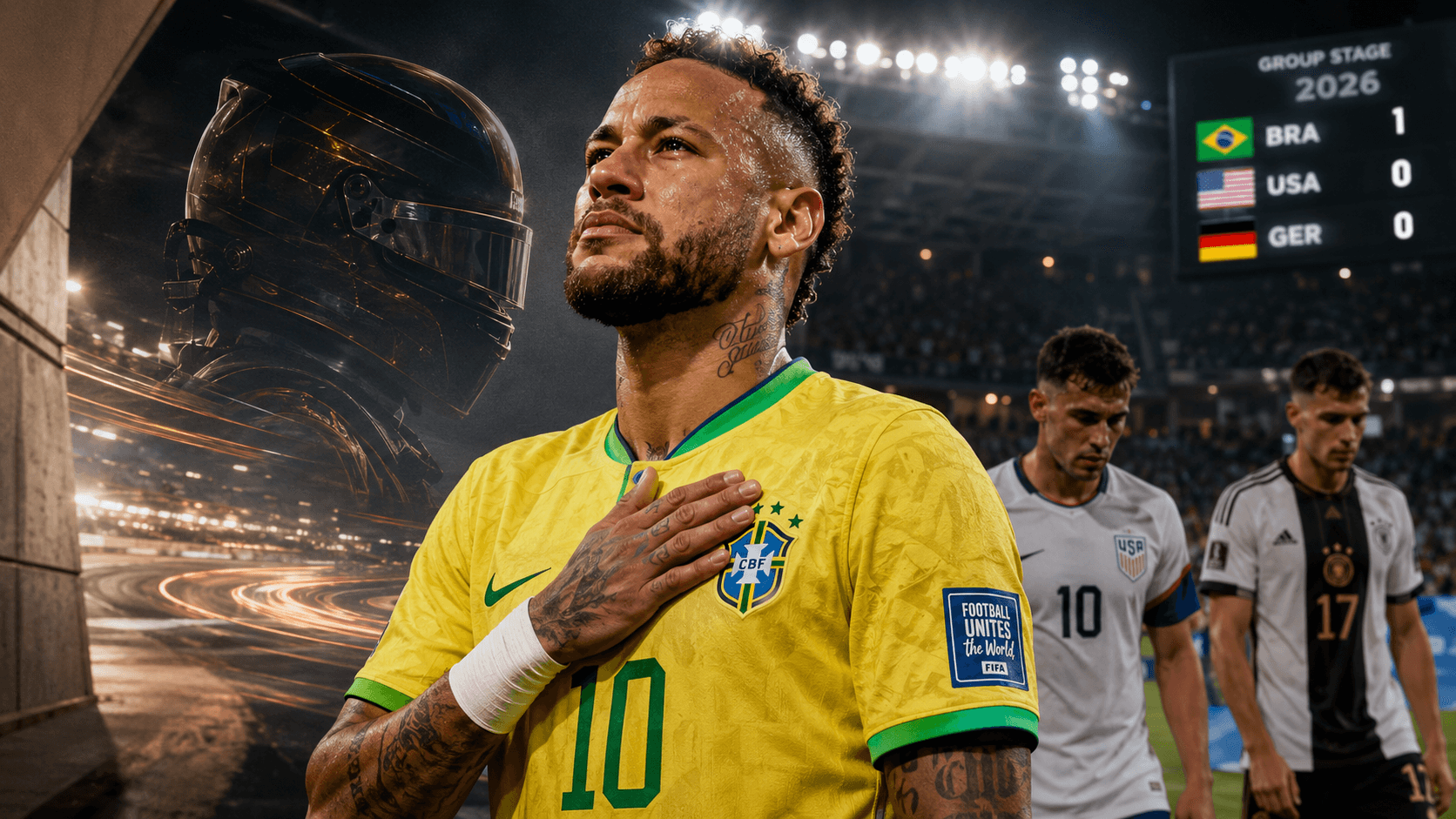
Neymar’s return was not just another substitution. It was a release.
For 981 days, Brazil waited to see Neymar back in the yellow shirt. For 981 days, the country’s all-time leading scorer lived with injuries, doubts, criticism and the uncomfortable question that follows ageing superstars at World Cups: is there still one last act left?
Against Scotland, the answer finally began to arrive.
Brazil were already in control when Neymar stepped onto the pitch in Miami, but the moment still felt bigger than the scoreline. The Seleção were cruising towards a 3-0 win, the group was being secured, and yet the loudest emotional note of the night came when the 34-year-old forward entered the game after almost three years away from the national team.
It was not the Neymar of old, bursting through defenders as the undisputed face of Brazil. This was a different version: older, more fragile, visibly moved and perhaps more human than ever. After sitting out Brazil’s first two matches with a calf problem, his return was greeted not just as a tactical boost, but as a reminder of how much history he still carries.
A comeback powered by emotion
Neymar’s comeback came with an unexpected layer of inspiration. According to ESPN’s World Cup Daily coverage, the Brazil forward had drawn motivation from Lewis Hamilton, another global sporting icon with a deep emotional bond to Brazil.
The connection makes sense. Hamilton’s relationship with Brazil has never been casual. His admiration for Ayrton Senna, his love for Brazilian sporting culture and his public affection for the country have made him more than just an outside admirer. For Neymar, a player who has often carried Brazil’s footballing hopes on his shoulders, the Hamilton link adds a powerful emotional thread: greatness, pressure, pain, recovery and identity.
Neymar has lived all of that.
There have been tournaments where Brazil expected him to be the saviour. There have been nights when his body failed him. There have been years when the criticism grew louder than the appreciation. Yet here he was again, not as a guaranteed starter, not as the sole symbol of the project, but as a player still desperate to matter.
That may be what makes this comeback so compelling. Neymar no longer needs to be everything for Brazil. But he can still be something important.
Brazil have changed while Neymar was away
The most fascinating part of Brazil’s 3-0 win over Scotland was that Neymar’s return did not overshadow the football. It added to it.
Vinícius Júnior was the star of the night, scoring twice and showing once again that the attacking centre of gravity has moved. Brazil are no longer waiting for Neymar to create every decisive moment. They have Vinícius tearing into space, stretching defensive lines and carrying the fear factor that once belonged almost entirely to Neymar.
Matheus Cunha also added to the scoreline, giving Carlo Ancelotti another reason to believe this Brazil squad has the depth and balance required for a serious World Cup run. The win was clean, controlled and convincing. Brazil topped Group C with authority, and their place in the knockout stage now comes with momentum.
That is why Neymar’s return feels so important but also so delicate.
He is not returning to rescue a broken team. He is returning to a team that has already found rhythm without him. That changes the equation completely. Brazil do not need Neymar to dominate every attack. They need him to add intelligence, creativity, personality and composure when the matches become tighter.
In many ways, that may suit this stage of his career perfectly.
Ancelotti now has a beautiful problem
Carlo Ancelotti’s challenge is no longer simply whether Neymar is fit enough to play. It is how to use him without disturbing what is already working.
Vinícius gives Brazil directness. Cunha gives them movement and finishing. The midfield gives them structure. The defence has so far looked strong enough to allow the forwards to play with freedom. Neymar’s return adds another layer, but it also raises tactical questions.
Does he start in the knockout rounds? Does he remain an impact substitute? Does Ancelotti use him centrally, wide, or between the lines? Can Brazil carry Neymar, Vinícius and Cunha together against stronger opposition without losing balance?
These are not problems of weakness. They are problems of abundance.
The best teams at World Cups often need both: the players who can dominate from the start and the players who can change the emotional temperature of a game from the bench. Neymar may now belong more naturally to the second category, at least until his rhythm fully returns.
That should not be seen as a demotion. It may be the role that keeps Brazil dangerous for longer.
The World Cup is entering its pressure phase
Neymar’s return came as the tournament moved into the decisive final round of group-stage matches, with the knockout picture beginning to take shape. The United States, already through as Group D winners, still had the chance to sharpen their momentum against Turkey, while Germany faced Ecuador in a match carrying real consequences for Group E.
That is the rhythm of this expanded World Cup. Some teams are already thinking about rotation. Others are fighting for survival. Some stars are being protected. Others are being pushed to the limit. Every game now carries the feeling that the tournament is tightening.
Brazil, though, look increasingly like a team growing at the right time.
They have topped their group. Vinícius is flying. Neymar is back. The squad has depth, star quality and a manager who understands tournament control better than most. The emotional high of Neymar’s return could easily become a distraction, but if Ancelotti manages it properly, it could become fuel.
Neymar’s final dance may not need to be perfect
The temptation with Neymar is always to frame everything in extremes. Genius or disappointment. Saviour or liability. Hero or distraction.
But perhaps this World Cup demands a more mature reading.
Neymar does not need to be the player he was in 2014. He does not need to carry Brazil as he did in 2018. He does not need to explain every scar from 2022. What Brazil need now is a version of him that understands the moment: experienced enough to slow games down, brave enough to demand the ball, humble enough to fit into a team that has evolved.
There was something powerful about seeing him return not as the centre of the universe, but as part of a wider Brazilian story. The tears, the nerves, the ovation and the Hamilton-inspired sense of renewal all pointed to the same truth: Neymar still cares deeply.
For Brazil, that matters.
World Cups are won by tactics, structure and quality, but they are also won by emotion. The right emotional spark can pull a squad closer together. Neymar’s comeback may do exactly that.
The Seleção are not simply entering the knockout rounds with three more goals, another clean result and a group-winning campaign. They are entering with their most famous player back in the room, their new attacking leader in devastating form, and the sense that something is beginning to gather.
Neymar may no longer be Brazil’s whole story.
But in this World Cup, he may still have one beautiful chapter left to write.