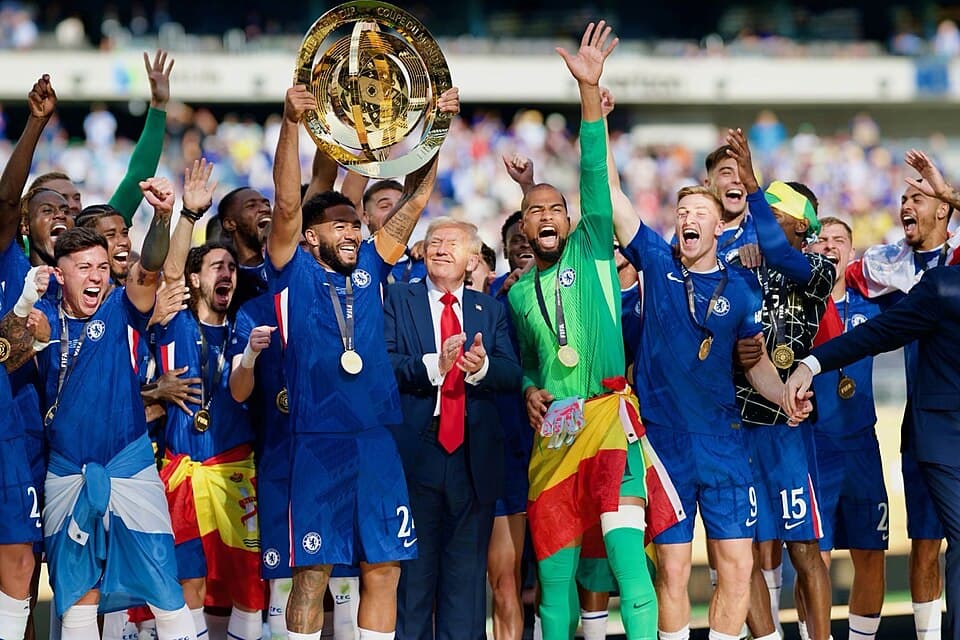
FIFA’s Club World Cup is no longer just a tournament. It is becoming a power project.
The competition that Chelsea turned into an £84m triumph last year is already moving towards its next major evolution, and the consequences could be huge for Europe’s richest clubs — especially in England.
FIFA has agreed to create a joint venture with European Football Clubs, the powerful lobby group now known as EFC, to help operate the Club World Cup. On paper, that sounds like another piece of football administration. In reality, it could be the moment the tournament shifts from FIFA’s ambitious global experiment into a much more commercially aggressive super-competition.
The next edition, scheduled for 2029, is now expected to expand from 32 clubs to 48. That would mean more matches, more broadcast inventory, more commercial value and, crucially, more places for Europe’s biggest sides. For Premier League clubs who missed out on the first expanded edition, this could be the opening they have been waiting for.
Chelsea’s victory in the inaugural 32-team version showed exactly why the pressure for expansion has grown so quickly. The London club did not simply collect another international trophy; they walked away with a financial reward that made the rest of Europe pay attention. When one summer tournament can generate Champions League-level money, the clubs left outside the gates are not going to stay quiet for long.
Why the Premier League has so much at stake
The previous format restricted entry to two clubs per country, unless extra places were earned through Champions League wins. That rule helped protect the global spread of the tournament, but it also produced an awkward commercial problem: some of the biggest domestic champions in Europe were absent.
Liverpool, Barcelona and Napoli all missed out despite being national champions of England, Spain and Italy respectively. From FIFA’s point of view, that is a difficult sell. A Club World Cup designed to showcase the best of club football loses some of its shine when major champions are watching from home.
For English clubs, the proposed shift could be especially significant. Arsenal, Liverpool and Manchester City have all been positioned strongly in UEFA’s coefficient picture, and any removal or relaxation of the two-club-per-country limit would immediately increase the Premier League’s chances of sending more representatives.
That matters because English clubs already operate in the most commercially powerful domestic league in the world. Give them another route into a tournament with massive prize money, and the financial gap between the Premier League elite and the rest could widen even further.
This is where the debate becomes uncomfortable. Expansion may make the Club World Cup more attractive to broadcasters and sponsors, but it also risks turning the competition into another stage for Europe’s richest clubs. FIFA will present the project as global growth. The clubs will see it as a revenue opportunity. Critics will ask whether football’s calendar — and its competitive balance — can absorb another inflated tournament built around the demands of the elite.
EFC’s arrival changes the politics
The involvement of EFC is the key development.
FIFA ran the first expanded Club World Cup largely on its own terms. That created tension with European football’s powerbrokers, who were wary of another major competition being dropped into an already crowded calendar. But the mood has changed. Relations between FIFA, UEFA and the leading clubs appear to have softened, helped by the recognition that the Club World Cup is too lucrative to ignore.
EFC already has major influence over European club competitions through its relationship with UEFA. By entering a joint venture with FIFA, it now has a formal route into shaping the future of the Club World Cup too. That gives the clubs a stronger voice in commercial decisions, format discussions and potentially the distribution of money.
It also gives FIFA something it badly needs: buy-in from the clubs who make the product valuable. The Club World Cup cannot become a truly premium global event if Real Madrid, Manchester City, Liverpool, Barcelona, Bayern Munich, Arsenal, Chelsea and Paris Saint-Germain are not fully invested in it. FIFA may own the competition, but the clubs own the stars, the fanbases and the global attention.
That is why this agreement feels less like a routine partnership and more like a settlement. FIFA gets the club game closer to its side. EFC gets influence. The biggest clubs get a clearer pathway towards a tournament that could become one of the most valuable properties in football.
The money question will not go away
The prize money from the 2025 edition is the central reason this story matters. FIFA created a $1bn prize fund for the 32 participating clubs, with another solidarity model designed to support clubs who did not take part. Chelsea’s estimated £84m reward from winning the tournament became the headline figure, but the wider structure was just as important.
This was not a symbolic competition. It was a financial event.
For clubs managing wage bills, transfer spending, profitability rules and squad-building cycles, the Club World Cup is now impossible to dismiss. A place in the tournament can alter a budget. A deep run can change a transfer window. Winning it can reshape an entire summer’s financial planning.
But there is still a sensitive issue to resolve. Solidarity payments promised to non-participating clubs from last year’s tournament have reportedly not yet been distributed, with the confederations still needing to agree how the money should be shared. That delay matters because it cuts to the heart of FIFA’s argument.
If the Club World Cup is meant to benefit the global game, the money cannot only flow quickly to the clubs already rich enough to compete. FIFA and EFC will need to show that expansion does not simply reward those at the top while leaving everyone else with slogans and delayed payments.
A bigger tournament, but at what cost?
The logic behind a 48-team Club World Cup is obvious. More big clubs. More games. More markets. More television value. More sponsorship leverage.
But football is already close to saturation. Players are being asked to absorb longer domestic seasons, expanded European competitions, international windows, summer tournaments and now a bigger Club World Cup every four years. Managers may welcome the revenue, but they will not welcome the physical toll if their squads are pushed into another high-intensity tournament with limited rest.
There is also the sporting question. Expansion can create opportunity, but it can also dilute quality if the format is not carefully designed. The challenge for FIFA is to grow the tournament without making it feel bloated. The challenge for EFC is to protect club interests without making the competition look like another closed shop for Europe’s elite.
That balance will define the 2029 edition.
If FIFA gets it right, the Club World Cup could become a genuine global showcase: a tournament where Europe’s superclubs, South America’s giants, African champions, Asian contenders and North American powers meet in a meaningful competitive environment. If it gets it wrong, it risks becoming a money-first extension of the European football economy, dressed up as global inclusion.
Why this could reshape club football
The Club World Cup used to sit on the edge of the football calendar. It was respected, but rarely treated as a season-defining event by European clubs. That has changed.
Chelsea’s win proved the new format can deliver prestige and serious money. FIFA’s joint venture with EFC now suggests the next version will be bigger, more political and more aggressively commercial. The Premier League’s leading clubs will be watching closely, because expansion could hand them another route into global competition — and another financial advantage over rivals at home and abroad.
For FIFA president Gianni Infantino, this is a chance to strengthen FIFA’s control over the club game. For EFC chair Nasser Al-Khelaifi and Europe’s biggest clubs, it is a chance to shape the rules of a tournament they can no longer afford to ignore. For UEFA, it is a delicate balancing act: support the competition enough to keep peace with FIFA, but not so much that it threatens the Champions League’s status.
The next Club World Cup is still three years away, but the battle for its future has already started.
And if the two-club-per-country cap is lifted, Premier League clubs may be among the biggest winners.